Managing a modern photovoltaic plant is a complex task that requires pinpoint precision. With the expansion of renewable energy, the ability to oversee and control large-scale assets has become essential to guarantee profitability and operational efficiency. If you are wondering what a SCADA system is, the short answer is that it acts as the centralized “brain” of a solar plant.
What is a SCADA System? Technical Definition
The term SCADA stands for Supervisory Control and Data Acquisition. Essentially, it is a hardware and software architecture that allows operators to monitor, collect data, and control photovoltaic plant equipment from a remote or centralized location.
When we talk about what a SCADA system is—an indispensable tool today—we are referring to a technological ecosystem that gathers information from sensors, inverters, meters, and weather stations, transforming raw data into strategic decisions. Without a robust system, managing a multi-megawatt plant would be unfeasible, inefficient, and prone to human error.
How Does a SCADA System Work in Practice?
To fully understand what SCADA is and its operation, we must visualize its workflow:
- Data Acquisition: Field devices (inverters, solar trackers, radiation meters) continuously send data through a communications network.
- Processing: This data reaches central servers that process the information and execute commands if necessary.
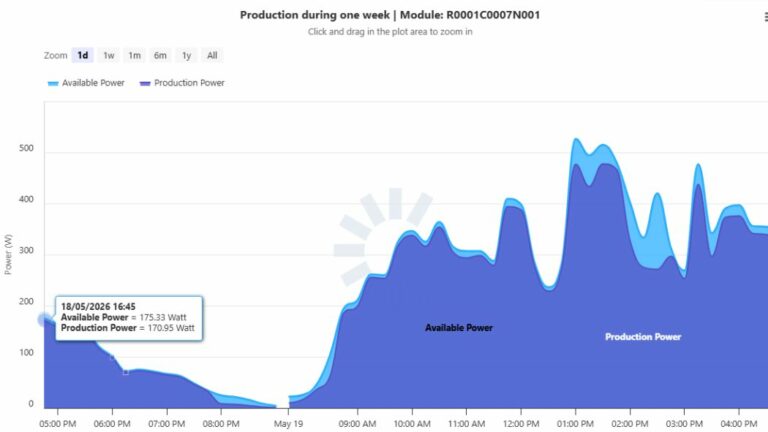
- Interface (HMI): The information is presented on a Human-Machine Interface, where operators visualize production graphs and fault alarms.
This flow allows for excellent general management, but what happens when we need to go beyond general data and detect specific failures in each module?
Importance in the Photovoltaic Industry: Global Vision vs. Detail
Implementing a SCADA system is not just a matter of convenience; it is a competitive necessity for three main reasons:
- Performance Ratio (PR) Optimization: It identifies deviations in energy production in real-time.
- Predictive Maintenance: It allows for a proactive response to breakdowns through historical analysis.
- Reporting and Compliance: It automates the generation of technical reports.
However, traditional SCADA systems often have a limit: they offer a “macro” view of the park. For advanced photovoltaic installation maintenance, it is necessary to go down to the “micro” level: understanding what is actually happening in each panel.
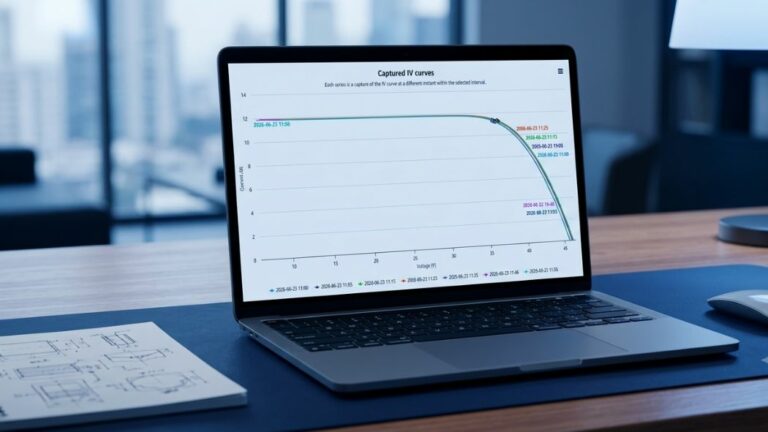
This is where Clever Solar comes in. While SCADA handles the global management of the asset, Clever Solar acts as a deep diagnostic layer. Thanks to our patented hardware technology, we measure I-V curves directly at the module level, offering a level of precision that general systems cannot always reach.
How Do We Complement Your Current Infrastructure?
At Clever Solar, we understand that you don’t want to complicate your operational architecture with complex integrations. That is why our technology has been designed to be a stand-alone system:
- No Integration Hassles: Clever Solar does not replace or need to integrate with your existing SCADA systems. We work in parallel, providing an extra layer of intelligence.
- Precision Diagnostics: By measuring I-V curves at the module level, we detect specific issues that SCADA might overlook, helping you make much more accurate O&M decisions.
- Total Flexibility: If you need to correlate our findings with your general reports, you can easily export all diagnostic data via API or CSV.
In summary, the key to a high-performance photovoltaic plant is not choosing one over the other, but combining the robustness of a SCADA system for general control with the diagnostic intelligence of Clever Solar to maximize the lifespan and real production of every single one of your modules.